LC Filter Design
Calculation Results
Pi Topology (C-L-C Shunt-First)
| Component | Ideal Value | Standard E12/E24 | Error % |
|---|
T Topology (L-C-L Series-First)
| Component | Ideal Value | Standard E12/E24 | Error % |
|---|
Calculate inductor and capacitor values for low-pass, high-pass, bandpass, and bandstop LC filters. Supports Pi and T topologies, Butterworth and Chebyshev responses, and outputs attenuation, Q-factor, and resonant frequency. Free, instant, no sign-up required.
What Is an LC Filter?
An LC filter is a passive electronic circuit that uses an inductor (L) and a capacitor (C) together to pass or block specific frequency ranges. Unlike RC filters, which convert rejected signal energy into heat through a resistor, LC filters store and return energy reactively - making them nearly lossless. This efficiency is why LC filters are the dominant choice in two very different fields: RF engineering (where every fraction of a dB matters) and power supply design (where wasted watts drive up heat and cost).
The physics is straightforward. An inductor's impedance rises with frequency
(ZL = 2πfL), so it naturally blocks fast-changing high-frequency
signals while passing slow DC and low-frequency currents. A capacitor does the opposite
- its impedance falls with frequency (ZC = 1/(2πfC)),
blocking DC while shorting out high-frequency noise to ground. Combining them in
different circuit arrangements produces all four fundamental filter types.
🔵 Low-Pass
Passes DC and low frequencies. Blocks high frequencies above cutoff. Inductor in series, capacitor to ground. Use for: power supply smoothing, audio bass, anti-aliasing.
🟡 High-Pass
Blocks DC and low frequencies. Passes high frequencies above cutoff. Capacitor in series, inductor to ground. Use for: RF coupling, audio treble, harmonic amplification.
🟢 Bandpass
Passes a band of frequencies around a center frequency. Blocks above and below. Series LC resonator in the signal path. Use for: radio IF filters, RF channel selection, AM/FM tuning.
🔴 Bandstop (Notch)
Passes all frequencies except a narrow band around the notch frequency. Parallel LC resonator to ground. Use for: 50/60Hz hum rejection, image rejection, interference removal.
Pi vs T Topology - The Correct Component Values
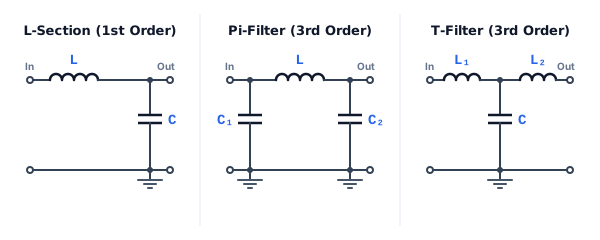
Both Pi and T filters give the same −3dB cutoff frequency and the same rolloff slope for identical L and C values. The difference is how the components are arranged - and critically, a Pi filter has two capacitors and one inductor, while a T filter has two inductors and one capacitor. The calculator shows the correct values for each element:
π (Pi) Filter - C·L·C
Two shunt capacitors (one at each end) with one series inductor in the middle. Best for high source/load impedances. Dominant in power supply design - the input cap stores charge, the inductor blocks ripple, the output cap smooths.
Lseries = L
where L = Z0/(π×fc), C = 1/(π×fc×Z0)
T Filter - L·C·L
Two series inductors (one at each end) with one shunt capacitor to ground in the middle. Best for low source/load impedances. Less common than Pi in power supplies but preferred in some RF ladder networks.
Cshunt = C
where L = Z0/(π×fc), C = 1/(π×fc×Z0)
Butterworth vs Chebyshev - Choosing a Filter Response
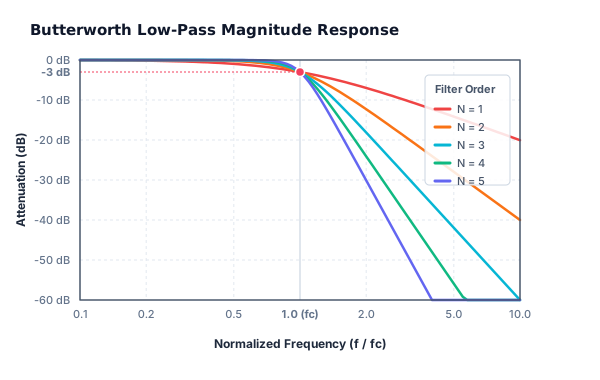
The Butterworth response has the flattest possible passband - no amplitude ripple whatsoever. The tradeoff is a relatively gentle transition from passband to stopband. It is the default choice for audio, instrumentation, and any application where passband flatness is a hard requirement.
The Chebyshev response deliberately introduces small, equiripple variations in the passband (selectable: 0.5dB, 1dB, or 3dB) in exchange for a significantly steeper rolloff at the same filter order. For RF interference rejection and harmonic filtering, a 3rd order Chebyshev often outperforms a 5th order Butterworth - with fewer components.
| Property | Butterworth | Chebyshev |
|---|---|---|
| Passband ripple | None (maximally flat) | 0.5–3 dB |
| Rolloff sharpness | Moderate | Steeper (same order) |
| Transient response | Good | More ringing |
| Component count | Higher for same stopband | Lower for same stopband |
| Best for | Audio, precision, ADC anti-alias | RF, interference rejection |
LC Filter Formulas Reference
2nd Order Butterworth - Core Formulas
Inductance
L = Z₀ / (π × fc)
Capacitance
C = 1 / (π × fc × Z₀)
Resonant Frequency
f₀ = 1 / (2π√(LC))
−3dB Cutoff
fc = 1 / (2π√(LC)) = f₀
Rolloff (2nd order)
−40 dB/decade (−12 dB/oct)
At 2× Cutoff
≈ −12 dB attenuation
Rolloff and Attenuation Reference
| Filter Order | Components | Rolloff | At 2× fc | At 10× fc | At 100× fc |
|---|---|---|---|---|---|
| 1st order (RC) | 1 R + 1 C | −20 dB/dec | −6 dB | −20 dB | −40 dB |
| 2nd order (LC) | 1 L + 1 C | −40 dB/dec | −12 dB | −40 dB | −80 dB |
| 3rd order (LCL) | 2 L + 1 C | −60 dB/dec | −18 dB | −60 dB | −120 dB |
| 4th order (LCLC) | 2 L + 2 C | −80 dB/dec | −24 dB | −80 dB | −160 dB |
| 5th order | 3 L + 2 C | −100 dB/dec | −30 dB | −100 dB | −200 dB |
Practical Applications
Power Supply Output Filter - A Pi filter (C-L-C) placed after a rectifier and before the load is one of the oldest and most effective ripple-reduction techniques. The first capacitor catches the peaks of the rectified AC waveform; the inductor blocks the ripple frequency from passing further; the second capacitor smooths the remaining ripple. For a 50Hz rectifier, a 10mH inductor and two 470µF capacitors reduce ripple by over 40dB.
RF Transmitter Harmonic Filter - Every radio transmitter produces harmonics at 2×, 3×, 4× the carrier frequency. Regulations (FCC Part 97 for amateur radio, ETSI for commercial) require harmonics to be suppressed by 40–60dB below the carrier. A 3rd or 5th order Butterworth low-pass filter immediately after the final amplifier stage provides this suppression. For a 100MHz FM transmitter, a 50Ω, 3rd order LP filter with fc = 130MHz gives >50dB attenuation at 200MHz (2nd harmonic).
Speaker Crossover Network - A 2nd order LC crossover at the −3dB point separates frequencies between drivers. For an 8Ω speaker system with a 3kHz crossover: the woofer low-pass uses L = 8/(π×3000) ≈ 0.85mH and C = 1/(π×3000×8) ≈ 13.3µF. The tweeter high-pass swaps the roles, using C in series and L to ground. Unlike RC crossovers, LC networks waste no power in resistors - all signal energy reaches the drivers.
Radio IF Filter - Superheterodyne radios amplify a fixed intermediate frequency (typically 455kHz for AM, 10.7MHz for FM). A tight bandpass LC filter at the IF stage rejects adjacent-channel interference with a Q-factor of 50 or more, enabling channel spacing as narrow as 9kHz in AM broadcast bands.
✅ Impedance Matching
Always design for the actual source and load impedances. For RF: 50Ω is standard. For audio speaker crossovers: use the nominal driver impedance (4Ω, 6Ω, or 8Ω). Mismatched Z0 shifts the actual cutoff frequency from the calculated value.
⚠️ Inductor Q Limits Insertion Loss
Real inductors have winding resistance (DCR) that causes passband loss. A 5th order RF filter with Q=50 inductors loses ~1dB in the passband. For audio, use iron/ferrite core inductors. For RF above 30MHz, use air-core or toroidal high-Q inductors.
⚠️ Inductor Saturation
Iron and ferrite cores saturate if the DC current exceeds the inductor's rated saturation current. Saturation causes the inductance to collapse, effectively removing the filter. For power supply filters, always choose an inductor with saturation current ≥ 2× the peak load current.
⚠️ LC Resonance Ringing
If the load is suddenly removed from an LC filter, the stored energy in L and C has nowhere to go and the circuit rings (oscillates) at f0. Add a small damping resistor (R ≈ 0.1–0.3 × Z0) in series with the output capacitor to control ringing without significantly degrading filter performance.
Frequently Asked Questions - LC Filter Design
What is the LC filter formula?
2nd order Butterworth: L = Z₀/(π×fc) and
C = 1/(π×fc×Z₀).
For 50Ω at 100MHz: L = 50/(π×100×10⁶) = 159nH,
C = 1/(π×100×10⁶×50) = 63.7pF.
Pi filter vs T filter - which should I use?
Pi (C-L-C) for high impedance source/load - dominant in power supplies. T (L-C-L) for low impedance source/load - used in some RF ladder filters. Both give identical fc and rolloff; the choice affects impedance matching at the input and output ports.
Butterworth or Chebyshev?
Butterworth: maximally flat passband, gentler rolloff. Use for audio, instrumentation, and ADC anti-aliasing. Chebyshev: allows passband ripple (0.5–3dB) for steeper rolloff with fewer components. Use for RF filtering and interference rejection.
How do I calculate an LC bandpass filter?
For center frequency f0, bandwidth BW, impedance Z0:
L = Z0/(π×BW), C = BW/(Z0×(2πf0)²),
Q = f0/BW.
Example: 455kHz IF, 10kHz BW, 50Ω → L = 1.59mH, C = 243pF, Q = 45.5.
How much attenuation does a 2nd order LC filter give?
−40 dB/decade (−12 dB/octave). At 2× fc: −12 dB. At 10× fc: −40 dB. At 100× fc: −80 dB. Each additional order adds 20 dB/decade of rolloff.
Why use LC instead of RC filters?
LC filters are lossless - they store and return energy reactively rather than burning it in a resistor. This matters in power supplies (efficiency) and RF circuits (signal loss). RC filters are simpler, cheaper, and suitable for audio and signal conditioning where small power losses are acceptable.
What impedance should I use?
RF circuits: 50Ω (universal standard). Audio speaker crossovers: nominal driver impedance (8Ω typical). Power supplies: match source and load impedance for the ripple frequency. Mismatched Z0 shifts the actual cutoff from the designed value.
What is a notch filter and how do I design one?
A notch (bandstop) filter rejects a specific frequency while passing all others. A parallel LC circuit resonates at f0 = 1/(2π√(LC)) and presents a very high impedance at that frequency, blocking it. Common use: 50Hz mains hum rejection in audio equipment. For 50Hz notch with 50Ω: L = 50/(π×10) = 1.59H - very large, so active RC notch filters are preferred at audio frequencies.
Advanced LC Filter Concepts
LC Resonance and the Q-Factor
When an inductor and capacitor are connected together, they exchange
energy at a natural resonant frequency: f₀ = 1/(2π√(LC)).
The Q-factor of the tank circuit determines how sharply it resonates:
Q = f₀/(Δf) where Δf is the −3dB bandwidth.
High Q (narrow bandwidth) is desirable for radio tuning circuits
but causes ringing (oscillation) in filter applications if the circuit
is underdamped. Always ensure your filter's load provides adequate damping
or add a small series resistance to the output capacitor.
Inductor Core Selection
The inductor core material dominates performance above a few kHz. Air core: lowest loss, highest Q, no saturation - ideal for RF filters above 1 MHz. Physically larger for the same inductance. Ferrite core: high permeability allows small size, good up to ~100MHz, but lossy above that. Best for RF chokes and EMI filters. Iron powder core: high saturation current, good for DC bias + AC signal (switching supplies). Lower Q than ferrite. Laminated silicon steel: only suitable below 1kHz - mains frequency transformers and audio output filters.
Self-Resonance of Real Inductors
Real inductors have parasitic capacitance between their windings. Above the self-resonant frequency (SRF), the inductor behaves as a capacitor - completely defeating the filter. For example, a 10µH inductor with 5pF parasitic capacitance has an SRF of about 22MHz. Using it in an RF filter at 100MHz is pointless - it has already stopped acting as an inductor. Always check the SRF in the component datasheet and keep your operating frequency below 50% of the SRF. Use our Planar Inductor to estimate SRF for PCB coils.
Component Tolerance and Frequency Error
Standard inductors carry ±5% to ±20% tolerance; standard capacitors ±5% to ±20%. Combined worst-case tolerance can shift cutoff frequency by ±10–20% from designed values. For audio crossovers: use 5% film capacitors and 5% inductors. For RF filters: use 1% NPO/C0G capacitors and precision RF inductors. The calculator outputs the ideal values - always verify with a network analyser or frequency response sweep on the actual built circuit.
Related Tools on CircuitsLab Wiki
- RC Filter Calculator - Single-pole RC low-pass and high-pass design
- Audio Crossover Calculator - Speaker crossover frequency and component values for 2-way and 3-way systems
- Planar Inductor Calculator - Design the PCB spiral inductors used in your LC filter
- Inductor Color Code Calculator - Identify axial inductor values from color bands
- Op-Amp Gain Calculator - Design active filter stages using op-amps and RC networks
- RF Link Budget Calculator - Calculate received power including filter insertion loss
Video: LC Filters Explained
Learn how LC low-pass & high-pass filters work, why LC is superior to RC for power and RF applications, and see real circuit demonstrations with oscilloscope measurements.

📺 Introduction to LC Filters - FesZ Electronics